
This Museum is Not Wasting a Good Crisis
This Museum is Not Wasting a Good Crisis
August 13, 2020 by Taylor Studios
This week’s blog comes from Kari Carlisle, Executive Director of the . You’ll love her insightful perspective on the difficulties facing the museum industry today. Be challenged and inspired to find the silver lining in the current crisis, and don’t let it go to waste!
With just one year under my belt as executive director for Heritage Square Foundation, I had time enough to identify all the aspects of the organization that needed work, and had given quite a bit of thought as to strategies and priorities.
Then there was COVID-19.
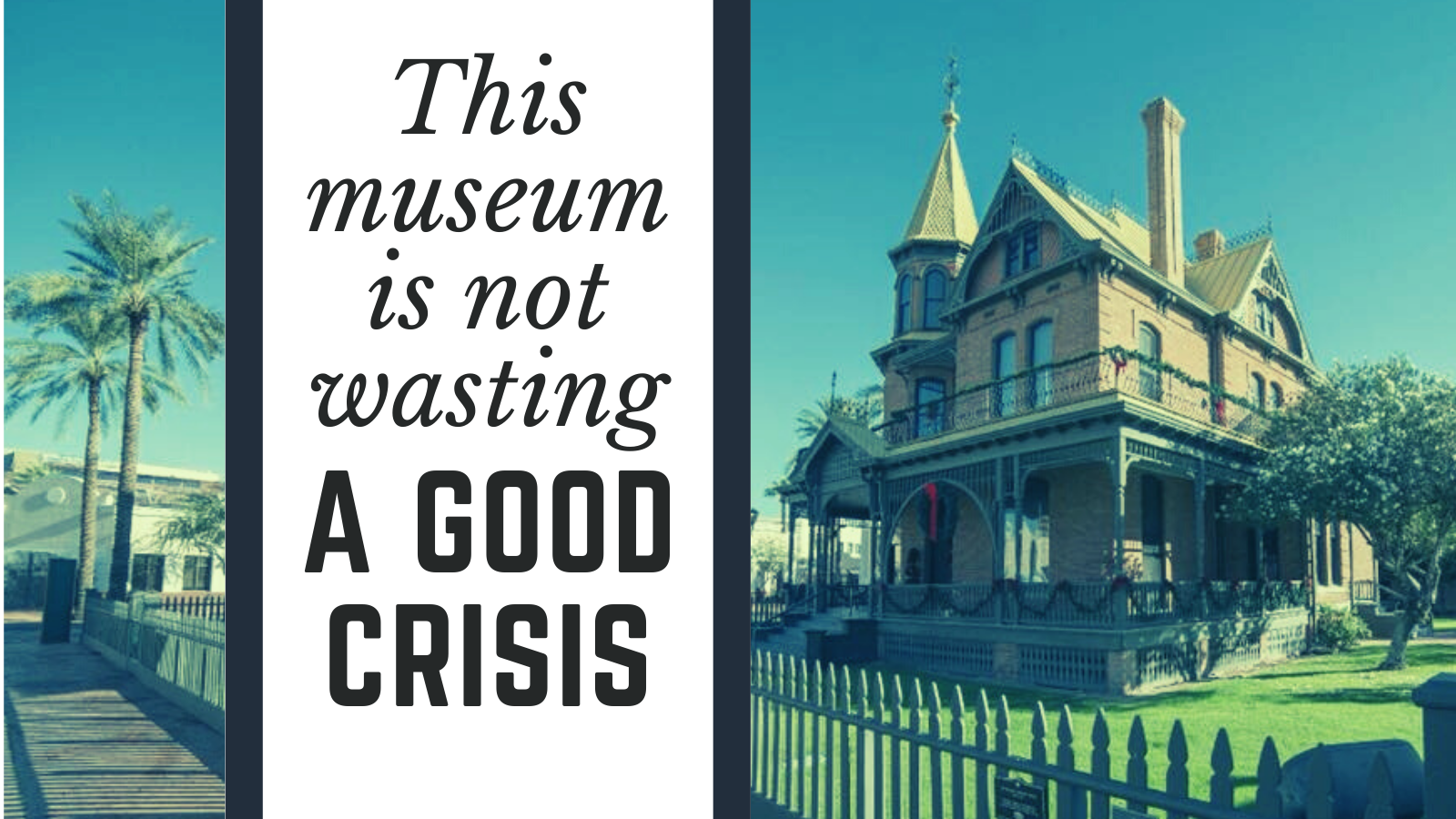
Heritage Square Foundation operates historic Heritage Square, the last remaining residential block of the original townsite of Phoenix. We have 10 historic buildings, including the Rosson House Museum, a Queen Anne Victorian home built by Dr. and Mrs. Roland Rosson in 1895. As a staff of 10, we provide tours, hold special events, run a museum store and facility rental business, as well as act as property manager for 3 high-end restaurants and a coffee roastery.
When the pandemic shut us and our tenants down, we quickly paid the price of relying too heavily on earned revenue. Like the rest of the world in turn, we put all plans on hold or completely scrapped them in favor of engaging our audience online, stopped any financial bleeding we could, and cried for help to everyone who would listen. Fortunately, we have been able to survive. So far.
Is it weird that I’m kind of excited about living through this pandemic? Don’t get me wrong – I’m probably as stressed and afraid as the average person, but the thought of going through such a historic event makes me think a lot about how historians of the future will look back on government and societal responses to it (yes, the future will hold all of us accountable) and how it shapes our world going forward, just as we look back on pandemics of the past.
The other thing that excites me about the current situation is the opportunity to reinvent ourselves, our organizations, and how we interact with our stakeholders. Prior to the pandemic, I was already slowly working toward a new organizational culture and new business models. Now that we’re facing an existential threat, suddenly staff and board buy-in are comparatively easy to achieve.
Pre-pandemic, I could clearly see the effects of the all-too-common perception that nonprofits should focus on mission and not be focused on making money. Who was the nincompoop who decided to call us nonprofits? The fact is, we cannot fulfill our mission if we don’t have ample resources to do so, and we can’t grow or expand our reach without growing our resources.
Since I have a background in the for-profit sector (I highly recommend young professionals work in two or more sectors early on in their career), I have the experience and knowledge to adapt for nonprofits some of the tools that profitable businesses use to increase revenues. I took the standard “sales funnel” or “marketing funnel” and created a “visitor engagement funnel”, which sounds much less scary to nonprofit staff and volunteers. The idea is to understand your customer (visitor), determine how in your very first connection with them you will hook them in, and then through a series of ongoing hooks, you continue to sell (engage) with your customer (visitor), making them loyal customers for years to come.
For a museum, the Visitor Engagement Funnel may start with simple word of mouth, leading someone to check the website for hours and pricing. The website entices the potential visitor with images of people having a great time at the museum, and the person is intrigued enough to visit (the first hook!). The visitor is impressed with the staff and volunteers, the museum itself, and the amazing stories they heard, so they decide to come back with a friend (another hook!). Staff hears this is a repeat visit (because they asked) and suggests the visitor would appreciate becoming a member (hook!). The visitor now gets many more benefits and each benefit leads to a series of hooks, and the visitor who becomes a member next becomes a donor and then a volunteer and then a recurring donor and then a board member and then an advocate and then a legacy donor…
This Visitor Engagement Funnel concept is powerful and can contain dozens if not hundreds of “hooks” that can be placed at every engagement connection (social media, website, visitor center, museum store, meetings, events, programs, etc.). You are not “tricking” anyone or acting like a used car salesperson. You are simply engaging with your visitors. Isn’t that what you’re supposed to be doing to begin with? But it becomes most effective when done deliberately.
Here’s a specific example of the Visitor Engagement Funnel in use. In January of this year, Heritage Square Foundation celebrated the grand opening of a traveling exhibit, “The Great Migration: Indiscernibles in Arizona.” The exhibit is based on local oral histories and focuses on the experiences of Black people in our state. Hundreds of people were able to see the exhibit before all our operations were closed due to the pandemic. A powerful exhibit that tells stories no one ever hears, it could not be silenced. We immediately reached out to its curator to help us continue telling these important stories on our website and through our social media channels. Then, the death of George Floyd and the resurgence of the Black Lives Matter movement made our efforts even more poignant.
We certainly could have left it there, and some might argue that we should have. On the web page that features the exhibit and provides links to more content, we also provide suggestions for items from our museum store. No, we are not capitalizing on this important moment in history, but rather we are providing suggestions for people who genuinely want to learn more on the topic, and yes, we are making money so that we can continue to work with members of the community to bring their stories to life and share them with our audience. You can judge for yourself:
Making money is not a bad thing. It is fundamentally critical to fulfilling our mission. How we make that money must be ethical, but we also cannot simply keep plugging away at our mission and expect money to just flow in. We must be strategic and methodical about how we go after money. And go after it we must. Money is by no means the only resource we need to fulfill our mission. I could have a million dollars and be utterly powerless without the support that comes from an empowered staff, engaged board, and enthusiastic volunteers.
Like most museums, ours has suffered, not only from being closed but also from the impact on our human resources. Staff members have been forced to adjust to working from home, abandon beloved projects, learn new digital skills, and suffer multiple periods of furlough, all while going through a stressful, scary pandemic. Board members are being called upon to go above and beyond the call of duty, getting involved in some of the operations to help ensure we survive this existential threat. And volunteers have become disengaged as most, being in the high-risk group for COVID-19 complications, stay home and stay safe, unable to help with virtual programming as they lack the resources and skills to do so.
So many are waiting on the sidelines for the pandemic to subside so that we can all go back to normal. Well, I hate to break it to you… we are unlikely to go back to normal, and do we really want to? I said earlier that I have been slowly steering the organization to new ways of doing things. The pandemic, in a sense, gives us all an excuse to make sweeping changes quickly. We just need to be careful to remain thoughtful about the process and how it affects the organization, our people, and our stakeholders.
Now is the time to analyze operations, restructure, and launch the New to meet the needs of our audience of the future. We must be willing to divorce everything we’ve been married to in order to start fresh. Anything that was not working – GONE. Anything toxic – GONE. Anything that will not resonate with our audience of the future – GONE. What is missing – ADOPT the things that matter now. It’s time to refocus on meeting the needs of our community going forward, and those needs will likely be different from before. The only way to know the needs of the community is to talk with the community and listen.
One way to do that is to invite community members onto your board. We are taking the opportunity – while we are closed, just starting a new fiscal year, and while minds are receptive – to rewrite our bylaws and restructure our board. By reducing our board to a mere 3-5 individuals who meet only for the bare essential functions required of a nonprofit board, we can create a secondary community board that doesn’t have to be constrained by formality. We will form new committees and engage the community board in activities that we really need them to do, such as fundraising, advocacy, and diversity and inclusion. By having a large, diverse community board, we extend our reach into the community, learning their needs and expectations, and hearing directly from them how we can be better leaders and servants for the community.
Which leads me to another important consideration – our mission. Created and adopted by our board several years ago, it’s brilliant in its simplicity: “Heritage Square, where past and present ignite imagination.” But it’s utterly useless in guiding our operation or convincing funders of our legitimacy. Reading more like a tagline, our mission statement desperately needs a complete overhaul. I anticipate board passage of new mission and vision statements within weeks of this writing.
No matter how this pandemic plays out, I expect Heritage Square Foundation to, well, have a stronger foundation for the future. Shoring up our strategies, restructuring for nimbleness and skills, and expanding our networking opportunities within our community will set the stage for our ability to act on upcoming opportunities.
If there is one takeaway from the situation we find ourselves in, it’s not to be reactionary or afraid of change. It may be human nature to resist change, but change can be effective and is essential for growth. In dangerous times, it’s understandable to want to do what is comfortable and feels safe. But it’s critical to “never waste a good crisis” as Winston Churchill is believed to have said.
©2020 Kari Carlisle, Executive Director, Heritage Square Foundation